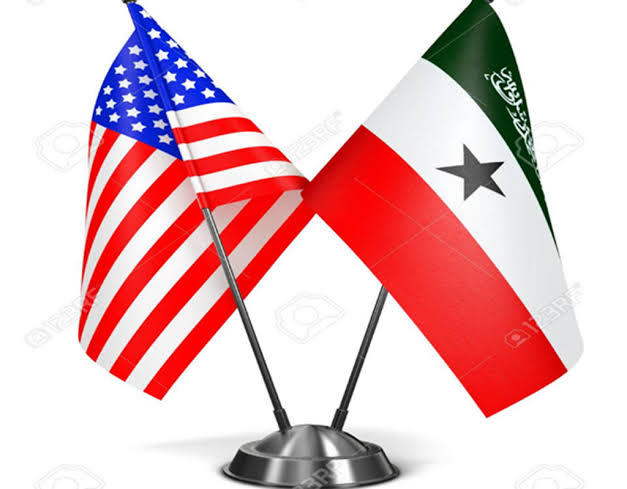
Somaliland’s President Abdirahman Cirro’s visit to the United States highlights two fundamental pillars that strengthen Somaliland’s case for international recognition
1. Geostrategic Value in Global Peace and Trade Bab el‑Mandeb Strait: Somaliland controls the longest coastline in the Gulf of Aden over 850 km directly adjacent to the Bab el‑Mandeb, a maritime chokepoint through which 34% of global trade goods and 12% of the world’s oil shipments pass.
This strait connects the Red Sea, the Indian Ocean, and the Mediterranean Sea, making Somaliland indispensable to global commerce. Regional Stability: Unlike its neighbors Somalia (state collapse), Sudan (civil war), Ethiopia and Eritrea (conflict), and Yemen (Houthi insurgency) Somaliland stands out as a stable, democratic, and peaceful polity. Its governance ensures that piracy, terrorism, and regional conflicts do not spill into the Red Sea corridor.
Security Nexus: Somaliland’s stability directly supports U.S. and allied interests in safeguarding maritime trade against threats from Iran, the Houthis, Al‑Shabaab, and regional instability. Without Somaliland’s democratic order, the Bab el‑Mandeb would be exposed to piracy, terrorism, and geopolitical sabotage.
Counterbalance to Turkey: Somaliland also acts as a bulwark against Turkish ambitions to destabilize the Red Sea for strategic leverage, including attempts to exploit Somalia’s state failure to foster piracy and insecurity
In short, Somaliland is the anchor of peace in the Horn of Africa and the Red Sea corridor, making it vital to U.S. national security and global economic stability
.2. Legal Basis for Recognition Absence of Binding Agreement with Somalia: Somaliland has never signed any binding treaty or agreement with Somalia that obliges it to remain part of a union. The 1960 union was never formalized under international law, and no registered treaty exists in the UN or other global institutions.
International Law Principle: Since no binding legal instrument exists, Somaliland’s claim to sovereignty is legally valid. Recognition of Somaliland does not violate any international obligation, nor does it undermine Somalia’s territorial integrity under law
Diplomatic Opportunity:
This legal clarity removes hesitation for states considering recognition. Unlike other secessionist cases, Somaliland’s independence is not a breach of prior agreements it is a restoration of sovereignty
Thus, recognition of Somaliland is not only politically justified but also legally sound under international law.
Conclusion
Somaliland offers the world and particularly the United States two irrefutable advantages
Geostrategic stability in one of the world’s most volatile yet economically vital maritime corridors
A legally uncontested claim to sovereignty, free from binding obligations to Somalia.
These twin pillars make Somaliland’s recognition both a strategic necessity and a legal inevitability.
For Washington and other global powers, engaging Somaliland is not charity it is a matter of safeguarding global trade, regional peace, and international law.
BY advocate Mohamed Mohamoud Hashi