When Francis Fukuyama declared the "end of history" in 1992, Western intellectuals mistook the exhaustion of Soviet communism for the permanent triumph of liberal constitutional democracy. Three decades later, as Donald Trump has challenged established democratic norms through populist politics, Elon Musk has acquired extraordinary private influence over the architecture of public discourse, and Western electorates have increasingly contested the very constitutional orders that produced their prosperity, the post-Cold War thesis looks less like a victory lap and more like a diagnosis of decadent boredom.
Fukuyama's critics frequently forget that his original thesis was never a naive promise of unending peace; it contained a deeply Nietzschean warning. In the shadows of The End of History and the Last Man lay the concept of thymos—the fundamental human craving for recognition, dignity, and distinction. Fukuyama correctly recognized that a political system dedicated primarily to material consumption, market efficiency, and technocratic management could eventually produce the "Last Man": a citizen secure enough to be comfortable, but potentially deprived of the larger struggles through which human beings have historically sought meaning and recognition. The danger was not that history would literally stop. It was that the human appetite for significance would survive the disappearance of grand ideological conflict. Figures such as Trump and Musk can therefore be read not simply as anomalies of the liberal order, but as manifestations of megalothymia—the desire to be recognized as superior—reborn within a post-Cold War political environment in which ideological struggles have increasingly been displaced into culture wars, identity conflicts, political spectacle, and digital arenas of influence.
Where Fukuyama's thesis proved vulnerable was in its teleological confidence: the assumption that liberal democracy possessed an almost inevitable gravitational pull toward which human governance would ultimately converge. History has not behaved so obediently. Liberal states themselves can decay from within. Institutions can become immobilized by competing veto players. Political parties can prioritize obstruction over governance. Interest groups can capture public institutions. Hyper-partisanship can turn constitutional safeguards into weapons of political combat. And economic systems can weaken the social foundations upon which democratic legitimacy depends. Fukuyama himself later developed the language of vetocracy to describe one dimension of this institutional paralysis: a condition in which too many actors possess the capacity to block government action, producing institutional sclerosis rather than effective governance. Nor can the consequences of neoliberal financialization, rising inequality, and hyper-individualism be dismissed as peripheral to the problem. When economic and political systems cease to generate a convincing sense of reciprocal obligation, the social contract becomes increasingly difficult to sustain. History did not end. Its engine was simply idling while its structural joints corroded.
In his later assessments, Fukuyama has consequently presented a far more sobered picture of the contemporary democratic order. The triumphalist certainty of the early post-Cold War period has given way to concern about democratic recession, political polarization, institutional decay, and the tensions internal to liberalism itself. His Liberalism and Its Discontents is particularly relevant here. The paradox is that liberalism's own triumphs can generate some of the conditions of its vulnerability. Its emphasis on individual autonomy, personal choice, and suspicion of excessive communal authority can, when detached from reciprocal obligation, produce a politics in which every group demands recognition while becoming less willing to recognize the legitimate claims of others.
Identity politics can similarly transform a universal language of dignity into competing claims of group entitlement when no sufficiently strong civic framework exists to reconcile them. Fukuyama's answer is not abandonment of liberalism. It is a recovery of balance: liberal rights accompanied by civic obligation; individual freedom restrained by institutional prudence; and political pluralism sustained by a shared civic framework. Rights without responsibilities do not necessarily produce freedom. They can produce fragmentation.
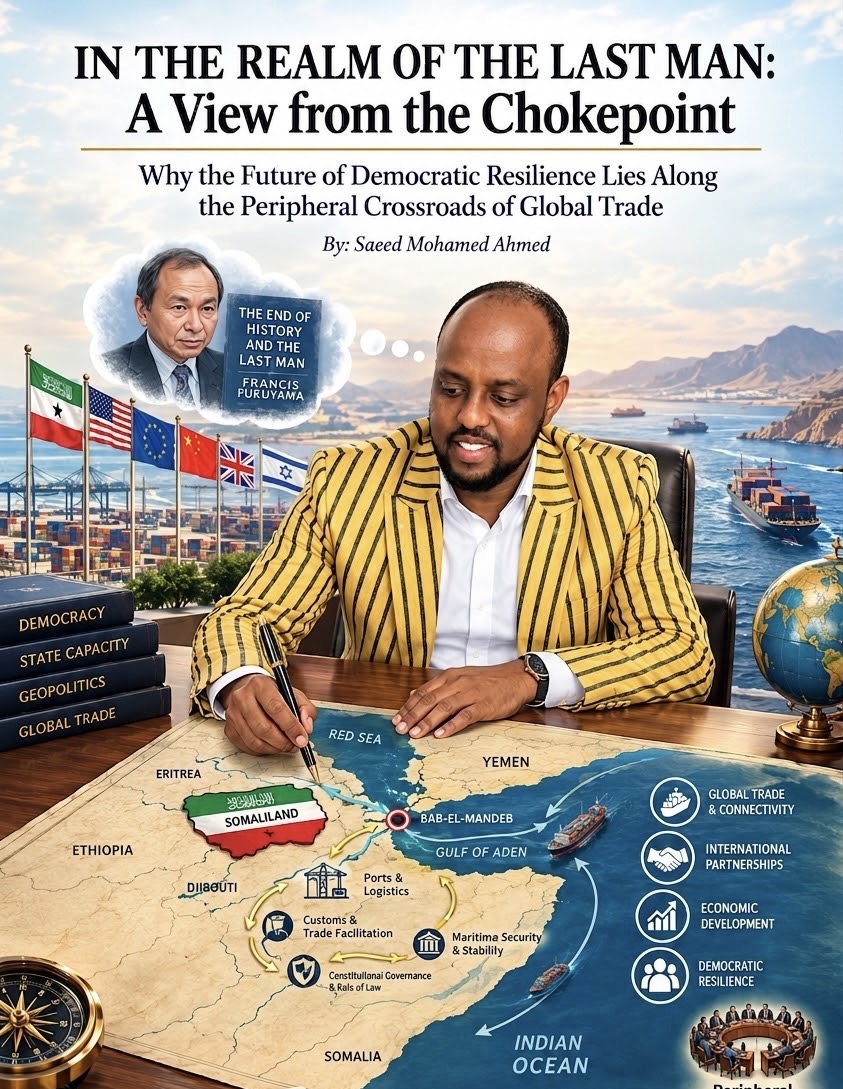
From where I write—overlooking the narrow, high-stakes waters of the Bab-el-Mandeb, watching global commerce move between the Red Sea, the Gulf of Aden, the Indian Ocean, and onward toward the Strait of Hormuz—this Western crisis of democratic fatigue reads with startling irony.
Here, in the Horn of Africa, constitutional order is not merely a background condition of everyday prosperity. It is an existential discipline. In a political environment where sovereignty, security, recognition, commerce, and institutional survival remain intimately connected, the state cannot afford to become invisible.
This vantage point suggests what might be called Chokepoint Institutionalism: the distinctive political logic that emerges when a state's strategic environment is shaped by its proximity to a narrow and indispensable artery of global commerce. Unlike many states of the Western core, whose institutions matured across long periods of accumulated wealth, administrative consolidation, and relative strategic insulation, states positioned along strategic corridors operate under conditions of persistent external scrutiny and vulnerability. Their institutional failures can have consequences beyond their borders. Their institutional successes can acquire strategic value beyond their borders. Their sovereignty is therefore not merely declared. It must be continuously demonstrated through the functioning of institutions: the security of territory and maritime approaches, the reliability of ports, the credibility of customs systems, the administration of borders, the predictability of regulation, the professionalism of public institutions, and the diplomatic agility required to navigate competing external interests.
The institutions that matter most in such environments are not merely those that facilitate democratic comfort. They are institutions that enable survival under pressure. Professional security forces. Competent port authorities. Transparent customs regimes. Credible courts. Capable public administration. Reliable infrastructure. And political institutions are sufficiently legitimate to prevent competition for power from becoming competition through violence. This is the essence of Chokepoint Institutionalism.
The question of how Chinese pragmatism and Anglo-American constitutional idealism might be synthesized for such contexts is therefore not merely academic. Beijing offers one model of infrastructure-first development, long-horizon strategic planning, state coordination, and an emphasis on sovereignty and non-interference that appeals to states weary of Western conditionality. Washington and London, by contrast, represent traditions in which constitutional rights, judicial independence, political accountability, and human dignity occupy a central place in the architecture of legitimate government.
Neither model provides a complete answer. The first can demonstrate how to build capacity without necessarily providing sufficient safeguards against concentrated political power. The second can provide powerful mechanisms for limiting public authority without always guaranteeing the administrative capacity required to act decisively. A serious Chokepoint Institutionalism would therefore draw selectively from both. Chinese pragmatism in the mechanics of state capacity. Anglo-American constitutionalism in the architecture of legitimacy. The synthesis need not be philosophically elegant. It needs to work.
The Horn of Africa, with its patchwork of post-conflict political settlements and experiments in constitutional order, may yet demonstrate that the future of governance lies not in ideological purity but in the intelligent hybridization of available institutional tools. It is an architecture that the Republic of Somaliland has been building through its own experience of functional statehood, including the constitutional democratic system it has developed and sustained over most of the last three decades. Its experience should neither be romanticized nor dismissed. It should be studied.
While Western metropoles increasingly experience the strains of democratic self-sabotage—contesting judicial independence, weakening institutional norms, and turning constitutional guardrails into instruments of partisan conflict—nascent states on the geopolitical periphery continue to confront a more elemental problem: building order where disorder remains a recent memory.
For us, liberal constitutionalism is neither an imported luxury nor a post-historical guarantee. It is a practical instrument. With all its imperfections, constitutional democracy offers a mechanism for mediating deep communal fractures, restraining arbitrary power, organizing peaceful political competition, and protecting human dignity without requiring political disputes to be settled by the gun. That is not a theoretical luxury in the Horn of Africa. It is a survival mechanism.
This asymmetry points toward a compelling and insufficiently explored scholarly frontier: Chokepoint Institutionalism and Peripheral Thymos. How do functional political communities situated at vital global maritime crossroads construct durable democratic legitimacy when the traditional centres of liberal theory themselves experience institutional strain?
The question becomes particularly interesting when viewed through Fukuyama's concept of thymos. Much of the conventional discussion assumes that thymos becomes politically destructive when societies achieve material security but fail to satisfy the human demand for recognition. But what if thymos behaves differently at the geopolitical periphery? What if the desire for recognition becomes constructive when recognition itself is connected to collective political existence?
This is Peripheral Thymos. At the margins of the international system, the demand for recognition can manifest not primarily as populist rage or personal status competition, but as a collective quest for sovereign legibility, constitutional governance, institutional survival, and international agency. The desire to be recognized can become a motivation to build institutions capable of demanding recognition. The distinction is profound. The Last Man seeks significance after history has supposedly ended. The peripheral polity seeks significance because history has never stopped pressing upon it.
This produces an inversion of the conventional Fukuyaman narrative. The political centre can experience institutional order as something inherited. The periphery experiences it as something constructed. The centre can regard constitutionalism as routine. The periphery may experience it as protection against renewed disorder. The centre can treat sovereignty as an assumption. The periphery may experience sovereignty as an unfinished institutional project. And the centre can afford political experimentation that damages institutional trust because the underlying architecture of the state is comparatively resilient. The periphery has less room for such experimentation. That does not make peripheral political systems inherently superior. It makes the stakes different. And where the stakes are different, institutional incentives can be different.
Somaliland provides a particularly revealing example of this phenomenon. Its contemporary political experience has been shaped by the interaction of constitutional governance, state-building, security, electoral politics, economic development, geopolitical uncertainty, and the continuing question of international recognition. Its political institutions therefore operate within an unusual environment. The state must demonstrate internal functionality while simultaneously navigating an international system that does not fully mirror its own conception of its political status.
That produces an unusual form of institutional pressure. Domestic governance becomes part of the argument for political legitimacy. Security becomes part of the argument for state capacity. Elections become part of the argument for democratic credibility. Public administration becomes part of the argument for sovereign competence. Diplomacy becomes part of the argument for international legibility.
This does not mean that institutional performance automatically produces international recognition. International recognition is shaped by power, interests, strategic calculations, regional politics, legal interpretation, diplomatic precedent, and the preferences of existing states. But institutional performance can change the substance of the question.
It changes the question from: Does this political community exist? to: What kind of political community has been constructed, and what does its experience teach us? That is a much more consequential question.
The same logic extends beyond Somaliland. The strategic coastlines of the Global South increasingly sit at the intersection of global commerce, infrastructure competition, maritime security, energy routes, digital connectivity, and great-power rivalry. The Red Sea and Gulf of Aden are among the clearest examples. These are not empty spaces between great powers. They are inhabited political environments whose institutions determine whether strategic geography becomes an economic asset, a security vulnerability, or both.
The states and political communities positioned along these corridors therefore face a distinctive strategic imperative: convert geographic exposure into institutional capability. A port can become a source of public revenue or private rent. A customs system can become an engine of state capacity or a mechanism of corruption. A strategic coastline can generate diplomatic leverage or external dependency. A constitutional system can mediate political competition or become merely decorative. Geography creates the opportunity. Institutions determine what is done with it. That is the central proposition of Chokepoint Institutionalism.
The revolt against liberal democracy in parts of the West may therefore represent something more complicated than the failure of liberalism. It may also reveal what happens when institutional success becomes invisible. Societies that have experienced generations of relative political stability can forget that constitutional order is an achievement rather than a natural condition. Societies closer to the raw edge of disorder cannot forget so easily.
For us, institutions are not scenery. They are infrastructure. Democracy is not simply a moral aspiration. It is a mechanism for managing political differences without violence. Constitutionalism is not merely an imported vocabulary. It is a technology for restraining power. Sovereignty is not only a legal proposition. It is a continuous institutional practice. And recognition is not merely diplomatic applause. It is the international acknowledgment of a political reality whose institutional substance must first be understood.
This is where the future of democratic theory may require a reversal of intellectual direction. For decades, the dominant model assumed that political knowledge travelled outward from the Western centre. The centre theorized. The periphery implemented. The centre developed. The periphery caught up. The centre produced institutional models. The periphery borrowed them.
But the twenty-first century may require a more reciprocal intellectual map. The established democracies possess enormous accumulated institutional knowledge. But the political periphery possesses something the centre increasingly lacks: the immediate experience of institutional necessity. At the chokepoint, state capacity cannot remain an abstract concept. The port must function. The border must be administered. The customs system must collect revenue. The security architecture must work. Political competition must remain sufficiently peaceful to preserve the state. Diplomacy must operate under pressure. Infrastructure must connect geography to economic opportunity. And institutions must survive the people who temporarily control them. That is not democratic theory from a textbook. It is democratic resilience under pressure.
The future of governance may therefore not belong to ideological purity. It may belong to institutional intelligence. A state does not need to choose between capacity and liberty. It needs capacity that serves liberty. It does not need to choose between strategic infrastructure and constitutional government. It needs infrastructure governed by institutions. It does not need to choose between sovereignty and international cooperation. It needs sovereign agency capable of choosing its partnerships. And it does not need to imitate either Beijing or Washington wholesale. It needs to understand what each can teach—and what each cannot. This is the intellectual promise of Chokepoint Institutionalism. It begins with geography. It ends with institutions. And between the two lies politics.
Fukuyama was right about one thing that remains difficult to escape: Human beings do not stop seeking recognition simply because material needs have been satisfied. But the political meaning of recognition changes according to circumstance. In affluent societies, thymos may become a struggle over identity, status, culture, influence, or personal distinction. At the geopolitical periphery, it can become a struggle for political dignity, sovereign agency, institutional credibility, and collective recognition. That is Peripheral Thymos. It is Thymos converted from grievance into institution-building. And if that transformation can be sustained, it may offer one of the more important clues to the future of democratic resilience.
The question is no longer simply whether history has ended. The question is: Where is history being built now? Perhaps not only in the grand capitals where political theory was traditionally written. Perhaps along the ports, borders, coastlines, and strategic corridors where statehood remains a daily act of construction. History has not ended. It has not even migrated. It has simply become more visible where the stakes are highest. The future of democratic resilience may therefore not be determined exclusively in the exhausted institutions of Washington, London, or Western Europe. It may also be shaped along the vital, high-stakes coastlines of the Global South—where sovereignty, commerce, security, constitutionalism, and recognition converge, and where the struggle to build functional statehood remains a matter of survival.
At the chokepoint, history is not over. It is under construction.
Author's Bio
Saeed Mohamed Ahmed is a researcher, writer, and former President of Gollis University. He served as the Chief Director of Communications, Media & Public Relations Division of the National Electoral Commission of Somaliland, and earlier as the Executive Director of SONYO Umbrella. He has led national-level programs at international organizations and was a vital member of the Young Professionals Program (YPP) at the Center for Public Policy.
With over 15 years of practical leadership experience across academia, governance, civil society activism, INGOs, and state-rebuilding—including consolidating democratic governance and electoral processes—he is an analyst on geopolitical dynamics and Horn of African affairs.
Saeed has authored and co-authored academic pieces, policy works, and strategic programs on Somaliland's development trajectory. He is a co-author of upcoming core books on Somaliland, its experience, and the lessons for the wider region and global contexts in post-conflict situations.
By: Saeed Mohamed Ahmed.